1. Introduction
In this post I outline the Buckingham  Theorem which shows how to use dimensional analysis to compute answers to seemingly intractable physical problems. For instance, in
  Geoffrey Taylor used the theorem to work out the energy payload released by the 1945 Trinity test atomic explosion in New Mexico simply by looking at slow motion video records. My main source for this post is Bluman and Kumei (1989).

Frame from slow motion footage of the Trinity nuclear test with a distance measurement showing the blast radius as well as a time measure showing seconds elapsed since denotation.
2. Basic Framework
The Buckingham Theorem concerns physical problems with the following form: There is a variable of interest,  , which is some unknown function of
  different physical quantities
  .
.
(1) 
Each of these physical quantities is composed of measurements in only  fundamental dimensions labeled
  . Thus, I can define a dimension operator which gives the dimensions of an arbitrary variable
  and write its output as:
(2) ![\begin{align*} \mathtt{dim}[z] &= \prod_{m=1}^{M} c_m^{a_m} \end{align*}](https://alexchinco.com/wp-content/ql-cache/quicklatex.com-ff6e8905c6069fe0bd1a5c013764d11e_l3.svg "Rendered by QuickLaTeX.com")
So, for example, if  is measuring pressure on the surface of a table, I could write
 ![\mathtt{dim}[z] = \mathtt{lb}/\mathtt{in}^2](https://alexchinco.com/wp-content/ql-cache/quicklatex.com-252cb8d0dbd7c6484c8d852f1c7d69f1_l3.svg "Rendered by QuickLaTeX.com") where
where  ,
,  ,
,  and
and  .
.
Definition (Dimensionless Quantity):
An arbitrary variable(3)
![\begin{align*} \mathtt{dim}[z] &= 1 \end{align*}](https://alexchinco.com/wp-content/ql-cache/quicklatex.com-d669db19da3dd913d6c5c6305773dea9_l3.svg "Rendered by QuickLaTeX.com")
3. Main Result
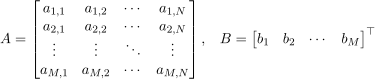
Now, I show how to reformulate this problem and apply linear algebra to the dimensional exponents to derive a characterization of the solution to  as a function of dimensionless quantities. First, I define
  as an
as an  matrix of dimensional exponents for
  and
and  as the
  vector of dimensional exponents for :
(4) 
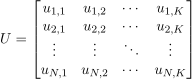
Next, we know that if has full rank, then there will  solutions to the system of equations
  . Define
  as this
  matrix of solutions.
(5) 
Finally, define  as the solution to system of equations
  :
:
(6) 
With these objects in hand, I can now state the Buckingham Theorem.
Proposition (Buckingham
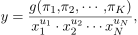
A physical systemwith
fundamental dimensions can be restated as:
(7)
where
,
is an unknown function and
are dimensionless parameters constructed from the physical parameters
using equations of the form below:
(8)

4. An Example
I now give an example of how to employ this theorem by working out the nuclear payload example from the introduction. For more information on this example, take a look at this blog post. Suppose that an atomic blast has a shock wave radius of  with variables:
 : Energery released by the explosion,
 : Time elapsed since the explosion took place,
 : Initial density, and
 : Initial pressure.
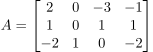
For this problem  and
and  with fundamental dimensions of length
  , mass
  , and time
  yielding the dimensional matrix written below:
(9) 
The energy (force) released by the bomb is the amount of mass accelerating through a unit square on the surface of the blast wave. Since  , we have only
  dimensionless constant which can be computed as the solution to the system of equations :
(10) 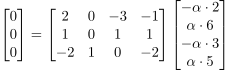
Setting the scalar free parameter  , I can write
  as:
as:
(11) 
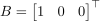
The dimension of the shock wave radius  is in units of distance yielding the dimension matrix below:
(12) 
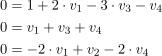
The system of  equations has
  unknowns:
(13) 
Thus, the vector will thus be defined up to a single free parameter  :
:
(14) 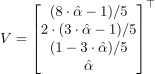
Using the formula  and tuning
  , I can compute as:
(15) ![\begin{align*} \pi &= \delta \cdot \left[ \frac{\epsilon \cdot \tau^2}{\rho} \right]^{-1/5} \end{align*}](https://alexchinco.com/wp-content/ql-cache/quicklatex.com-1f213f27573b8ace13b11e71f024fea4_l3.svg "Rendered by QuickLaTeX.com")
Combining all of these results yields a formulation for in terms of a constant  and an unknown function of the dimensionless quantity
  :
:
(16) ![\begin{align*} \delta &= \left[ \frac{\epsilon \cdot \tau^2}{\rho} \right]^{1/5} \cdot g \left( \pi_1 \right) \end{align*}](https://alexchinco.com/wp-content/ql-cache/quicklatex.com-bcf695b9b03b53105fec4823e9d50d35_l3.svg "Rendered by QuickLaTeX.com")
Taylor expanding around  where
where  yields a formulation where
  with scaling constant
  given by:
(17) 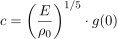
Setting  , the
, the  plot of vs yielded an accurate fit where the predicted values fall on the solid line and the (declassified) empirically observed values are denoted by
  ‘s in the plot below:

[…] at any one instant, most traders won’t immediately notice this event. The bomb has burst, but the blast wave hasn’t arrived yet. If people trade on coincidence, they will only notice this shock after […]