The question
Researchers currently take it for granted that CEOs should maximize PV[Shareholder Payouts]. Suppose we agree. Under this premise, max EPS is the wrong objective. It’s a misspecified model for how to run a firm. In work with Itzhak Ben-David, I show that EPS maximization solves the 3 core problems in corporate finance: capital structure, real investment, and payout policy.
How does max EPS survive? CEOs have access to textbooks, MBA programs, consultants, and analysts—all of which teach present-value logic. The data generated by decades of corporate decisions are available for everyone to examine. If max EPS is misspecified, why hasn’t it been abandoned?
Ba (2026) provides a formal theory of exactly this phenomenon: when and why misspecified models persist, even when decision-makers are open to switching and have access to infinite data. This note spells out the connection to EPS maximization.
Ba’s framework
An agent uses a subjective model  to guide decisions. Each period
  , she chooses an action
  from a finite set
  and observes an outcome
  drawn from the true (unknown) data-generating process
  . Her model is a parametric family of predicted DGPs,
  , where
  indexes the parameter space
  . The model is correctly specified if some recovers
  ; it is misspecified otherwise.
The agent holds a prior  over and updates beliefs via Bayes’ rule within the model. Crucially, she also considers a competing model
  with its own parameter space
  and prior
  . She compares models using the Bayes factor
(1) 
where  is the marginal likelihood of the data under model , and
  is the likelihood conditional on parameter .
As new data rolls in, the agent updates her Bayes factor recursively
(2) 
If  where
where  is a switching threshold, the agent switches to . If
  , she switches back. The threshold
  controls switching stickiness. A larger requires stronger evidence to switch.
| Ba (2026) notation | EPS vs. PV application |
|---|---|
| Initial model |
Max EPS |
| Competing model |
Max PV[Shareholder Payouts] |
| Action set |
Corporate decisions: leverage choice, project selection, payout policy |
| Outcome |
Observable corporate outcomes: EPS level, EPS growth, stock-price reaction, analyst response |
True DGP  |
The actual mapping from corporate decisions to outcomes (determined by the full economic environment) |
| Parameter space |
Parameters of the EPS model (earnings yield, interest rates) |
| Parameter space |
Parameters of the PV model (discount rates, growth rates, terminal values, risk premia, payout schedules) |
| Switching threshold |
Institutional friction: retraining costs, compensation redesign, regulatory reporting norms, board inertia |
Bayes factor  |
Cumulative evidence that PV logic fits the data better than EPS logic |
Result 1: Endogenous data lets misspecified models survive forever
The theorem
Theorem 1 (Ba 2026, p. 16). Suppose  . The following are equivalent:
- Model is globally robust for at least one full-support prior.
- Model is locally robust for at least one full-support prior.
- There exists a p-absorbing self-confirming equilibrium (SCE) under model .
A self-confirming equilibrium under is a strategy  supported by a belief
  such that (i) is myopically optimal given , and (ii) the model’s prediction matches the true DGP on the equilibrium path
(3) 
The strategy is p-absorbing if a dogmatic -modeler eventually plays only actions in  .
.
The key insight: a misspecified model need not be globally correct. It only needs to be correct on the equilibrium path—for the actions it actually induces. Off-path misspecification is never revealed because the agent’s own actions determine which data are generated. This is why endogenous data is essential: Ba (2026, p. 16, fn. 19) notes that “in an exogenous-data environment, Theorem 1 implies that the sufficient and necessary condition for both local robustness and global robustness is that the model is correctly specified.”
P-absorbingness adds a dynamic requirement on top of the static SCE condition. It is not enough for an SCE to exist; the agent’s belief dynamics must actually converge to it. Ba’s Section 5.2 (Proposition 2, p. 24) shows that this convergence property depends on the direction of belief reinforcement. When beliefs and actions are complements (so that the bias feeds on itself), the dynamics are positively reinforcing and convergence to the SCE is guaranteed. Hence, the SCE is p-absorbing. When beliefs and actions are substitutes, the bias is self-correcting. Dynamics may oscillate and fail to converge. A SCE exists but is not p-absorbing, and the misspecified model is not robust.
Application to EPS
When a CEO maximizes EPS, her decisions shape the observable corporate outcomes. The EPS model’s predictions are tested only against data generated by EPS-driven actions. Predictions about actions a CEO never takes are never tested.
Leverage. An EPS maximizer borrows when  (earnings yield exceeds the interest rate) and uses the proceeds to retire shares. This raises EPS mechanically. The outcome the CEO observes is: EPS went up, the stock price did not collapse, analysts applauded the “accretive” transaction. The EPS model’s prediction that the transaction would be good because it is accretive is confirmed by the data the decision itself generated. The CEO does not observe the counterfactual: what would’ve happened under the PV-optimal leverage choice given frictions.
Investment. An EPS maximizer uses  as the hurdle rate, not the WACC. She rejects projects with positive NPV but negative first-year EPS impact (dilutive projects) and accepts projects with negative NPV but positive first-year EPS impact (accretive projects). The observed outcome: EPS did not fall, the project looks like it “worked.” The NPV of rejected projects is never observed.
Payout. An EPS maximizer buys back stock whenever buybacks offer a higher yield than investing cash ( ) rather than evaluating the NPV of the buyback. The observed outcome: EPS went up, the market reacted positively to the announcement. The PV counterfactual (could the cash have been better deployed elsewhere?) is off-path.
Let  be the strategy induced by max EPS, and let
  be a parameter value in the EPS model under which the predicted outcome distribution matches
  for all
  . Then
  is an SCE under the EPS model. This is plausible because the EPS model does not mispredict the direction of EPS changes from leverage, buybacks, or accretive acquisitions. It correctly predicts that borrowing at
  raises EPS, that using cash for buybacks at raise EPS, and so on. What it gets wrong is the welfare interpretation: whether these EPS changes correspond to value creation. But welfare is not directly observed in ; what is observed are EPS changes, stock-price reactions, and analyst ratings, all of which are consistent with the EPS model’s on-path predictions.
Moreover, the EPS model’s feedback dynamics are positively reinforcing in the sense of Ba’s Proposition 2: EPS-driven decisions raise EPS, which validates the model, which strengthens conviction, which leads to more EPS-driven decisions. This positive feedback ensures that the SCE is p-absorbing. Contrast this with the dynamics facing a CEO who switches to PV logic: she accepts a dilutive acquisition, EPS falls in the short run, analysts downgrade, the stock price drops, and the PV model appears to have failed, creating pressure to revert. The transition to the correct model generates short-run data that seem to disconfirm it. By Theorem 1, the existence of a p-absorbing SCE under the EPS model is sufficient for it to be globally robust. Hence, EPS maximization can persist against any competitor, including PV logic, with infinite data.
Result 2: Concise models can be more robust than correct ones
The theorem
Theorem 2 (Ba 2026, p. 19). Suppose and model has no traps. Then:
- Model is globally robust at prior if and only if
 .
. - Model is locally robust at all full-support priors if and only if
 .
.
 is the set of consistent parameters: those for which the pure belief
  supports a p-absorbing SCE. The model’s prediction under matches the true DGP at every action in the equilibrium strategy’s support.
The condition links three forces: the model’s structure (which determines ), the agent’s prior (which determines how much mass falls on ), and the switching threshold (which sets the bar). Prior tightness and switching stickiness are substitutes: a higher lowers the bar for prior concentration, and a tighter prior lowers the bar for stickiness. Any asymptotically accurate model can be globally robust at a given prior, provided switching is sufficiently sticky.
The critical implication: correctly specified models are not necessarily more robust than misspecified ones. A misspecified model with a smaller parameter space  can satisfy the tightness condition more easily. Under an ignorance prior (uniform over ), each parameter receives weight
  . For a model where every parameter is consistent (
 ), the tightness condition is automatically satisfied at any , regardless of the prior—the model is unconditionally globally robust. But a correctly specified model with a large parameter space needs a correspondingly tight prior to be globally robust, and under a uniform prior it may fail. Ba (2026, p. 4): “simple misspecified models equipped with entrenched priors can be more robust than complex correctly specified models.”
In the media-bias application (Section 5.1, Proposition 1), Ba makes this concrete: a two-state misspecified model  is globally robust at all priors and all , while the correctly specified three-state model is globally robust only if
  . The misspecified model permanently replaces the correct one with arbitrarily high probability as the prior on the extreme states increases.
Application to EPS
The EPS model has a small parameter space. For any given decision (borrow or not, invest or not, buy back or not), it requires the CEO to know essentially two things: the earnings yield ![\mathrm{EY} = \frac{\mathbb{E}[\mathrm{EPS}]}{\mathrm{Price}}](https://alexchinco.com/wp-content/ql-cache/quicklatex.com-c0add3dc0d03f887e57c709f41ccc232_l3.svg "Rendered by QuickLaTeX.com") and the relevant financing cost (interest rate
and the relevant financing cost (interest rate  or risk-free rate
  ). The decision rule is a direct comparison: act if and only if
  , where .
The PV model requires knowledge of a much larger parameter space : the risk-free rate, market risk premium, firm beta (or multi-factor betas), the project-specific risk adjustment, the terminal growth rate, the expected path of future cash flows, and the probability distribution over states of the world.
Under Theorem 2, the prior tightness condition for global robustness is . For the EPS model, if encompasses most or all of (because the model is consistent for the small set of parameters it uses), then  is close to 1 and the condition is satisfied for any . The EPS model may be unconditionally globally robust.
For the PV model, even though it is correctly specified ( ), the prior mass is spread across a large parameter space. Under a diffuse prior,
  may be small. The PV model is locally robust at all priors (by Theorem 2(ii)), but it is globally robust only if
  . With large
  and diffuse prior, this can fail.
Moreover, switching stickiness in corporate settings is very large. Compensation contracts are tied to EPS targets. Analyst coverage is organized around EPS estimates, consensus forecasts, and PE multiples. Regulatory reporting (GAAP earnings) makes EPS the most salient and auditable metric, while PV calculations involve subjective inputs (discount rates, growth assumptions) that are harder to audit and verify. Board education is required to shift from a direct comparison (“is this accretive?”) to a multi-parameter model (“what is the NPV at the appropriate risk-adjusted discount rate?”). All of this amounts to a very high , which further lowers the bar for the prior tightness that the EPS model must satisfy.
Result 3: Even slight switching friction is enough
The theorem
Theorem 3 (Ba 2026, p. 21). Suppose model has no traps and  . Then model is locally or globally robust at any full-support prior if and only if .
When switching is non-sticky (), local and global robustness coincide, robustness at some prior is equivalent to robustness at all priors, and both hold only when every parameter in the model is consistent. This is an extreme demand: the model must be correct for every DGP it entertains, not just on the equilibrium path. Only a model with full prior tightness () can survive frictionless comparison.
The set of robust models shrinks discontinuously at . For any , models with  can be robust (provided the prior tightness condition is met). At , they cannot. Ba (2026, p. 21): “the set of locally robust models and supporting priors shrinks discontinuously at , which highlights how stickiness helps more misspecified models persist.”
The mechanism: at , there always exists a nearby competing model that fits the data slightly better than the initial model on some dimension. Because there is no switching friction, this marginal improvement is sufficient to trigger a switch. The proof constructs such a competing model by preserving most DGPs in while slightly improving the accuracy of one DGP associated with a parameter in  .
.
Application to EPS
Theorem 3 clarifies that the persistence of max EPS depends on switching friction being positive—but the required friction can be arbitrarily small. For any (even  ), the EPS model can be globally robust provided the prior tightness condition is met. The discontinuity at means that even minimal institutional friction (a small cost of retraining, a slight reluctance to abandon a familiar framework) is qualitatively different from zero friction.
This matters because it addresses a potential objection: “surely CEOs could switch to PV logic if they wanted to; there’s no real barrier.” Ba’s result says that even a negligible barrier is enough, as long as it is positive. The EPS model does not need an enormous moat to survive. It needs (i) a p-absorbing SCE (Result 1), (ii) sufficient prior concentration on consistent parameters (Result 2), and (iii) any positive switching friction at all (Result 3). The first two conditions are structural properties of the EPS model. The third is almost trivially satisfied in any real institution.
Conversely, Theorem 3 identifies the knife-edge case where EPS would be displaced: a world with literally zero switching costs () and a PV model that is a slight local improvement. In practice, this would correspond to an environment where CEOs face no career risk from short-term EPS misses, no analyst pressure around quarterly earnings, and no cognitive cost of estimating multi-parameter discount rates. These conditions do not describe any real-world setting.
Summary
Ba (2026) provides a formal framework for understanding when misspecified models persist despite competition from correctly specified alternatives. Applied to the EPS-vs.-PV question, the theory identifies three reinforcing mechanisms, one per main result.
| Result | Mechanism | Application to EPS |
|---|---|---|
| Theorem 1 | Misspecified model is robust iff it admits p-absorbing SCE; endogenous data insulates on-path predictions from off-path errors | Accretive actions generate data that confirm max EPS model; positive feedback dynamics ensure convergence to SCE |
| Theorem 2 | Global robustness requires  ; concise models concentrate priors; stickiness and prior tightness substitutes ; concise models concentrate priors; stickiness and prior tightness substitutes |
EPS model’s small parameter space makes tightness condition easy to satisfy; minor frictions and reporting norms matter |
| Theorem 3 | Set of robust models shrinks discontinuously at ; any positive friction qualitatively expands what can persist |
Even minimal switching costs suffice for EPS to survive; knife-edge case (zero friction) does not describe real world |
The punchline: even if we take as given that maximizing PV[Shareholder Payouts] is the correct objective, the Ba (2026) framework gives formal reasons—grounded in Bayesian learning theory—for why maximizing EPS can persist indefinitely. The misspecified model is not merely sticky due to inertia or ignorance. It is robust in a precise sense: it admits a self-confirming equilibrium, its directness concentrates prior beliefs, the data it generates through the CEO’s own actions provide continuous apparent validation, and even minimal institutional friction is enough to protect it. These forces can be strong enough that the correct model is permanently abandoned.
Caveat: Is max PV[Shareholder Payouts] actually the correct model?
Everything above assumes that maximizing PV[Shareholder Payouts] is the correctly specified model. It’s the true DGP against which max EPS is judged misspecified. Ba’s framework requires us to designate one model as correct and ask whether the other persists. We chose PV as the correct model because that is what finance theory prescribes. But this assumption deserves scrutiny.
Shareholders do not get to spend corporate earnings. Earnings are an accounting construct; they accrue to the firm, not to the shareholder’s bank account. A dollar of EPS that is retained and reinvested never reaches the shareholder at all. In that sense, maximizing EPS is maximizing a fiction—a number that does not correspond to any cash flow the shareholder actually receives.
But PV[Shareholder Payouts] has a parallel problem. Shareholders do not get to spend the present discounted value of a dollar they expect to receive in 20 years. You cannot eat risk-adjusted returns. The “present value” of a distant payout is a mathematical object, not cash in hand. And yet these distant, heavily discounted payouts are the primary drivers of valuation in the PV framework.
The Gordon growth model makes this concrete. Under the standard formulation, an asset’s price equals expected cash flow next year times a forward-looking multiple
(4) ![\begin{equation*} \mathrm{Price} = \mathbb{E}[\mathrm{CF}] \times \bigg( \frac{1}{\mathrm{r} - \mathrm{g}} \bigg) \end{equation*}](https://alexchinco.com/wp-content/ql-cache/quicklatex.com-32e2a66ccb6c7671aca55da2afccc1a9_l3.svg "Rendered by QuickLaTeX.com")
For typical parameter values ( ,
,  ), the multiple is roughly
  . But
. But  is also the Macaulay duration of the cash flow stream in years. So the “typical” dollar of present value corresponds to a payout roughly two decades in the future. The PV framework asks the CEO to make decisions today based on the risk-adjusted value of money that shareholders will not receive for 20 years. This is money that never appears on a financial statement, whose value depends on estimates of discount rates and growth rates that are themselves deeply uncertain.
This does not mean PV logic is wrong. It means that both models involve abstractions, and the question of which abstraction is “correct” is less obvious than textbook finance suggests. EPS is a fiction because earnings are not payouts. PV is a fiction because present values are not cash. The Ba (2026) framework shows that even if we grant the PV model the status of correct specification, the EPS model can persist indefinitely. But if we take seriously the possibility that neither model is unambiguously correctly specified, then the persistence of max EPS becomes even less surprising. In Ba’s terms, we may not be in a world where a correctly specified competitor exists at all, in which case the question is not whether EPS will be abandoned but which misspecified model proves more robust. Regardless, history has shown that EPS wins.
![\Exp[ \, \textit{Discount Rate} \times \textit{Future Payout} \, ]](https://alexchinco.com/wp-content/ql-cache/quicklatex.com-c3474b541c2b839f5672485b8f8a7806_l3.svg "Rendered by QuickLaTeX.com") will increase. If the asset’s current price doesn’t increase accordingly, any trader who sees the signal could profit by buying a share,
will increase. If the asset’s current price doesn’t increase accordingly, any trader who sees the signal could profit by buying a share,  :
:![\begin{equation*} \Big( \, \underbrace{\Exp[ \, \textit{Discount Rate} \times \textit{Future Payout} \, ]}_{\substack{\text{Present\phantom{j}discounted\phantom{j}value\phantom{j}of} \\ \text{asset w/ same future payout}}} - \textit{Current Price} \, \Big) \times \Delta \end{equation*}](https://alexchinco.com/wp-content/ql-cache/quicklatex.com-fb156f255b42067f8c065daa42be19d3_l3.svg "Rendered by QuickLaTeX.com")
 in a world where traders saw a negative signal.
![\Exp[ \textit{Discount Rate} \times \textit{Future Payout} \, ] > \textit{Current Price}](https://alexchinco.com/wp-content/ql-cache/quicklatex.com-6024c84856841df9327a1f6adeaf8c49_l3.svg "Rendered by QuickLaTeX.com") without traders taking action,
without traders taking action,  . However,
 ![\begin{equation*} - \Big( \, \underbrace{[\textit{Unlevered Firm's Value} - \textit{Value of Debt Issuance}]}_{\substack{\text{Cost of building a portfolio that buys unlevered firm and} \\ \text{shorts the debt issued by otherwise identical levered firm}}} - \textit{Equity Value of Levered Firm} \, \Big) \times \Delta \end{equation*}](https://alexchinco.com/wp-content/ql-cache/quicklatex.com-85e9b48bdcf1c04093603c894ecd52cd_l3.svg "Rendered by QuickLaTeX.com")
 , in two particular years,
  . For simplicity, I’m going to talk about Prop 99 as a policy that banned indoor smoking outright: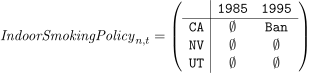
 denote the number of packs bought by the average person in state
  during year
  . You want to know how Prop 99 affected cigarette sales:
 , is the per capita cigarette sales observed in California during 1995 after Prop 99 had been implemented. The second term,
  , reflects packs per person during 1995 in an alternative world where everything is the same except that Prop 99 was never passed.
 term, had an effect on cigarette sales in California. i.e., you want to know whether
  . If Prop 99 had no effect, then
  .
. ).
). represents liquor consumption in state
  packs per year relative to California in the figure. Thus, using Nevada during 1995 as your counterfactual observation would cause you to overstate the true causal effect of Prop 99 by
  is the average per capita cigarette sales during year
  . However, in its initial configuration, cigarette sales are constant over time in the figure above,
  . If that were the case, then you could use per capita cigarette sales in California during 1985 as your counterfactual observation. But, by moving the
  slider, you can see how a downward time-series trend in cigarette sales would cause you to again overstate the effect of Prop 99:
![\begin{equation*} \Exp\big[ \, \underbrace{\mathit{CigSales}_{\texttt{CA}, \texttt{95}}(\texttt{Ban})}_{\text{observed}} - \underbrace{\mathit{CigSales}_{\texttt{CA}, \texttt{85}}(\mathtt{\emptyset})}_{\text{observed}} \, \big] = \Delta \mu + \alpha \end{equation*}](https://alexchinco.com/wp-content/ql-cache/quicklatex.com-0eb6dae91fda8592d5f114fe92b42d91_l3.svg "Rendered by QuickLaTeX.com")

 . But you could estimate these values using your 1985 data. And you could use these weights to construct a
 , this synthetic control also accounts for persistent differences in cigarette sales across states due to differing propensities to partake in all vices. And, if we’ve done everything correctly, then we can compute
![\begin{equation*} \Exp\big[ \, \underbrace{\mathit{CigSales}_{\texttt{CA}, \texttt{95}}(\texttt{ban})}_{\text{observed}} - \underbrace{\widehat{\mathit{CigSales}}_{\texttt{CA}, \texttt{95}}(\mathtt{\emptyset})}_{\text{calculated}} \, \big] = \alpha \end{equation*}](https://alexchinco.com/wp-content/ql-cache/quicklatex.com-27067f1286d7bd569bb9a8c526ad2a61_l3.svg "Rendered by QuickLaTeX.com")
 . While this approach has some advantages, it’s also somewhat unsatisfying in that there’s no real physical analog to the counterfactual it produces. There’s no process by which you can take a weighted average of Utah and Nevada. This is purely a statistical construct.
 is the prevailing risk-free rate at time
 ![X_n = \Cov[\mathit{Return}_{n,t}, \, \mathit{Market}_t] \, / \, \Var[\mathit{Return}_{n,t}]](https://alexchinco.com/wp-content/ql-cache/quicklatex.com-cd4dde6dd8be5a21ee315a8ef5aa3648_l3.svg "Rendered by QuickLaTeX.com") is the market beta on the
is the market beta on the  is price of an increase in exposure to this market risk factor:
 variables specified in the model, it shouldn’t be possible to find another predictor,
  , that forecasts returns:
 . If there are two other assets with betas equal to
  and
and  respectively, you should compare the
  . Exact same situation! And the original synthetic-control paper (
 different stocks,
  , and you want to make the best forecast possible for the future return of the
  st stock,
  . You have access to
  different return predictors. Let
  denote the value of the
  th predictor for the
  in the cross-section. Without loss of generality, also assume that the cross-sectional average return is zero.
 , then it’d be possible to estimate the OLS regression below:
 . If the predictor tends to be positive,
  , for stocks that subsequently realize positive returns,
  , then the OLS slope coefficient associated with it will be positive. It will also be profitable to trade on this predictor, too.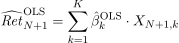
 . If you’ve got
  predictors and
  stocks in your training data, then you’re in business. However, if your training data only contains
  stocks, then you’re
 in front of the penalty term is a tuning parameter, which can be optimally chosen via
  , there is no penalty at all and the LASSO is equivalent to OLS. But when
  , the LASSO’s coefficients will differ from OLS estimates as shown in the interactive figure below.
 for all
  . In either case, we have:
 . Second, it forces all small OLS coefficients,
  , to be exactly zero,
  .
. of your
  observations to figure this out.
  data points should do just fine. An alternative approach to making a return forecast when
  would be to use a neural network. On the surface, this seems like a very different strategy. Instead of
  hidden nodes. The diagram to the left shows what this would look like in a situation with
  predictors and
  hidden nodes so that we can see what’s going on.
 ,
,  , or something else entirely.
  contains the weights that go into the
  elements due to the intercept term.
 , is then a weighted average of its
  hidden nodes where the weights are chosen by solving the optimization problem below:
 free parameters. In addition, you must also choose an activation function,
  .
. whenever
  . Let’s also assume a linear activation function,
  .
. and
and  . To estimate all
  of these values, we must maximize the objective below:


 changes in response to a change in
  . Notice how this effect is qualitatively different from the effect of increasing
  , the LASSO estimate always moved one-for-one with
  . And this makes all the difference. For any value of
  , we have that
 . This is just the
 ![\begin{equation*} \min_{\beta_1,\ldots,\beta_K} \, \sum_{n=1}^N \left\{ \, \mathit{Ret}_n - \sum_{k=1}^K \beta_k \cdot X_{n,k} \, \right\}^2 + 2 \cdot \lambda \cdot \sum_{k=1}^K |\beta_k|^q \qquad \text{where} \qquad q \in (0, \, 1] \end{equation*}](https://alexchinco.com/wp-content/ql-cache/quicklatex.com-41a80c226d09e1898c7ae2c0a2c6f698_l3.svg "Rendered by QuickLaTeX.com")
 . The note also shows that it’s possible to write
  people, of which,
  are currently sick. The remaining
  people are healthy. Each instant, a sick person encounters a healthy person with probability
  . And, when that happens, the healthy person becomes sick at a rate of
  per interaction. Otherwise, sick people recover with probability
  each instant. This implies that the total population of sick people will evolve as
![\begin{equation*} \mathrm{d}S = \underset{\text{contract disease}}{[\beta \cdot (H/N) \cdot S] \cdot \mathrm{d}t} - \underset{\text{get healthy}}{[\gamma \cdot S] \cdot \mathrm{d}t} \end{equation*}](https://alexchinco.com/wp-content/ql-cache/quicklatex.com-85201af680984c8abd60b6ffafc58453_l3.svg "Rendered by QuickLaTeX.com")
![\begin{equation*} \mathrm{d}H = \underset{\text{get healthy}}{[\gamma \cdot S] \cdot \mathrm{d}t} - \underset{\text{contract disease}}{[\beta \cdot (S/N) \cdot H] \cdot \mathrm{d}t} \end{equation*}](https://alexchinco.com/wp-content/ql-cache/quicklatex.com-db4335a5882bfa3581439f721e9c541a_l3.svg "Rendered by QuickLaTeX.com")
 people with a deadly disease and doctors are asked to choose between two treatments. Treatment A results in
  deaths. Under treatment B there is a
  chance that no one will die but a
  chance that all
  and treatment B kills everyone